If you are researching air source heat pumps, a common phrase you may come across will be ‘setback controls’. Whether you are looking to install a heat pump in your home or you already have a heat pump, understanding what setback controls do is important. In this article, we will explain how setback controls work and how they help a heat pump to operate efficiently.
Heating Solutions for Homeowners
Are you a Heating Professional?
Products
Knowledge & Support
Explore our Knowledge Hub:
Tips & Advice Education Area Case Studies The Grant House Virtual House FAQs Glossary Visit the Knowledge HubProducts
Unsure what you need?
Use our product finder tool
Knowledge & Support
Explore our Knowledge Hub:
Tips & Advice Education Area Case Studies The Grant House Virtual House FAQs Glossary Visit the Knowledge Hub
Setback controls and heat pumps – what do they do?
|
With the number of homes being heated by an air source heat pump increasing year on year, it is more important than ever that homeowners understand how to correctly operate this type of low carbon heating system. In this blog about setback controls and heat pumps, we will:
Quick links for this blog...
In this blog, we will explain:
How are low temperature heating systems different to traditional boilers?
Air source heat pumps are low temperature heating systems. What this means is the temperature of the water flowing through the system (whether that be through radiators or underfloor heating) is lower than that in a conventional central heating system, such as a gas or oil boiler. Low temperature systems can still heat rooms to the same temperatures as fossil fuel heating systems but they usually require a larger surface area through which the heat can be emitted into the room.
Furthermore, to aid the efficient operation of a low temperature system, it is important to avoid large fluctuations in the room temperature throughout the day. Instead of letting a room get cold, the heating system should be set to maintain a comfortable and consistent temperature that the heat source can efficiently sustain and then, when a boost is required, the heat source will require minimal effort to achieve the warmer temperatures set. Contrastingly, if a room is allowed to significantly drop in temperature, when a higher temperature demand is called for, the heat source (such as a heat pump) will have to work harder to make up the greater difference in temperature. This is where setback controls come in…
What are ‘setback controls’?
In brief, setback controls enable an air source heat pump to operate as efficiently as possible while never being completely switched off. This set up, which your heat pump installer will be able to assist with during your system handover, will ask the heat pump system to operate during a series of ‘energised’ and ‘setback’ periods during the course of the day. The energised periods will be during the parts of the day when the home is occupied, usually first thing in the morning and evening. Meanwhile, the setback periods will be enabled during the unoccupied hours of the day and at night. Let us now look at what these two periods look like in reality.
Energised timings for a heat pump
When you first wake up and during the evening, you will want your rooms to be warmer so during the hours of 6am-9am and 6pm-10pm, your heat pump system can be set to operate in an ‘energised’ state. What this means is that the system will run at the required higher flow temperature and will be able to warm up the rooms to an average temperature of 21ºC, for example.
Setback timings for a heat pump
When you are away from the home or asleep, you will not require or need your rooms to be as warm as they are during the occupied periods referenced above, so this is when your heat pump system can be set to operate in a ‘setback’ state. When operating in setback mode, the system’s flow temperature will be reduced so that during the hours of 10am-4pm and at night, the average room temperatures can be 18-19ºC. The important point to note here is the difference in temperature between the energised and setback phases is not too large, just a couple of degrees.
Achieving efficient heat pump operation
This cycle of energised and setback periods will allow a heat pump to keep running, enabling it to operate very efficiently. This is because the cycle will prevent the room temperatures from significantly dropping and consequently, will prevent large fluctuations in temperature between the occupied and unoccupied hours. Instead of being switched off and then being required to work harder during the occupied hours to warm up cold spaces, the heat pump can run at lower flow temperatures more evenly throughout the day.
Adjusting your room temperatures – do’s and don’ts
We understand that sometimes you will want to change the temperature of a particular room – for example, you may want a room to be warmer than the temperature set in your heating schedule. Adjusting your room temperatures is fine provided you use the correct channels to do so. Here are some of our do’s and don’ts for controlling your heat pump:
- Do not tamper with the parameter values set by your heat pump’s controller - similar to how homeowners should not adjust their boiler’s thermostat, the core heat pump settings and parameters should not be adjusted either (these settings should only be accessed by your heat pump installer and service engineer)
- Do use your room thermostats to adjust the temperature of your room(s) – your home will typically have a room thermostat fitted downstairs and another upstairs which each control an area or room(s) so when you change the temperature on a room thermostat, it will trigger a temperature change only in the particular zone or room(s) it controls
- Do use third party app-enabled controls to adjust the temperature of your room(s) – this could include the ecoNet app which is compatible with the Grant Aerona Smart Controller, which allows you to make changes to your room temperatures when away from home.
To learn more about Grant’s Aerona heat pump controls, please visit our other blogs and digital resources by following the links below:
- Visit our Home Heating Blog to read about how to control a Grant air source heat pump
- Discover more about Grant’s range of air source heat pump controls
- Explore our Customer Support Hub and learn why heat pumps should not be switched off at night.
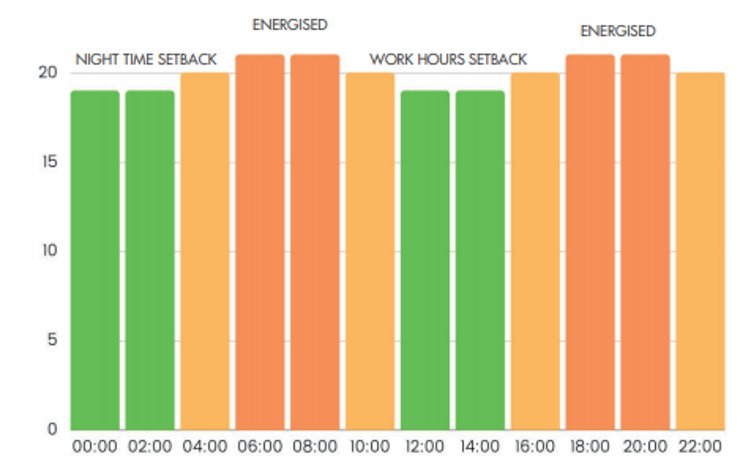
An example of typical temperature setback timings
Subscribe to Grant News
Receive the latest news and updates about Grant products and services